
Beep beep beep beep *smash*. 4.30am time to wake up. After almost two years of waking up at this crazy early hour you’d expect to get used to it. Nope. Still early, but duty, and more specifically the monkeys, call. Quick cold shower will get you going. Then 2 sandwiches each with peanut butter or jam, collect the telemetry, GPS, field book, observation papers and off we go. Finding our monkeys.
Radio telemetry
Most of our adult monkeys are equipped with a radio collar. This will give off radio signals that help us find them. You know, radio signals have the nasty habit to bounce against everything they encounter. And then I mean everything! Trees, leaves, rocks, branches, grass, fruits, seeds, each other, ground, you name it. Even the smallest water drop has influence. It also means that a signal coming from a clear direction might fool you since it bounced back. In other words, check properly and carefully in order to determine your direction. Then also during rainy season the signal will be absorbed by moisture, yes moisture in rainy season…won’t bother you with that story.
Lots of walking
 Our baboons walked a lot and it sometimes took 1.5 hour to reach them, the vervets make our life a bit easier and usually within half an hour we are with the monkeys. Sometimes they will greet us by making short contact sounds. Sometimes they are still resting or warming up in the sun or grooming each other. Quite a peaceful and relaxing moment. After doing a census to see if everybody is there safe and sound, we start observing.
But by then the monkeys are also wide awake and either playing, grooming, feeding and foraging, moving or, if nice and lazy (how we felt in the morning), still resting.
Careful not to disturb them
Moving around the group we need to be careful not to disturb their natural behaviour, but yet be able to keep a close eye on our study animal of that moment.  We follow the monkey of the moment through the woodland that out here is rather hostile, it seems like every plant has a thorns, hairs or stickiness. The ‘wait a bit tree’ with its strong hooked thorns are responsible for at least 80% of the tares in our clothes. Shoes will last 1 season, then the strong grass has cut them to pieces. Or ‘eaten them’ like the Malawians say. The vervets are not bothered and eat them in return. We follow and observe them from dusk till dawn.
Nature is your office
But it’s good. Can you imagine having nature as your office, following monkeys all day seeing their behaviour and be accepted as a part of their environment. The fact that the monkeys accept us will make it easier to spot other wildlife as well because apparently we are not dangerous. 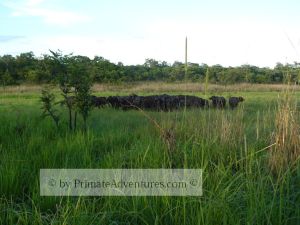 Roan, puku, kudu, duiker, reed buck, bushbuck, warthog, bush pig, elephant, sable, buffalo, we see them up close. Of course days can be hard with burning sun, long hours, pouring rain and not to mention tsetse flies and mozzies…But hey; no pain no game…And seeing these monkeys thrive in their wild life, having a 92% survival rate with the baboons and new borns being born wild and free are very rewarding results. The vervets have had a harder struggle, but seeing them overcome their fears and difficulties, seeing them learn how to survive and also become real wild and free monkeys is an amazing experience.
Knock off
Around 5.30pm we knock off, once we know the animals are safe and well back in their trees. We walk through forest and dambos to the car, drive back to our reed hut at the lake and see some wildlife on the way, cook diner on a fire by candlelight and our solar lamp, have a another cold shower and go to bed early. And before you know it…Beep beep beep beep…..
 Primate Adventures